For machine vision identification projects, the biggest fork in the road is usually speed versus detail. The Basler acA2000-50gcNOIRCUT offers color at up to 50 FPS over GigE, while the Basler acA5472-17um delivers 20 MP monochrome at 17 fps over USB 3.0. Both are used C-mount cameras from Basler's ace-series, so your lens arrangement stays similar; what changes is how much motion you can capture and how much pixel information you get in each frame.
Quick verdict: The acA5472-17um is the stronger candidate if your machine vision identification task needs high detail on a still or slow-moving subject and you are already on USB 3.0. The acA2000-50gcNOIRCUT is worth considering if you need color at high speed, but you must accept an untested unit that is described as For parts or not working.
Spec comparison at a glance
| Camera | Listed price | Price bar | Resolution | Color/Mono | Frame rate | Interface |
|---|---|---|---|---|---|---|
| Basler acA2000-50gcNOIRCUT | USD 369.99 | 2.2 MP (2048 x 1088) | Color | 50 FPS | GigE | |
| Basler acA5472-17um | USD 449.99 | 20 MP (5472 x 3648) | Monochrome | 17 fps | USB 3.0 |
Where each camera wins
- Resolution: The acA5472-17um's 20 MP sensor and 5472 x 3648 output dwarf the acA2000's 2.2 MP and 2048 x 1088 resolution. That makes the USB 3.0 camera the better match for identifying fine features or reading small codes in a still frame.
- Speed: The acA2000-50gcNOIRCUT's 50 FPS is the clear advantage when parts move quickly through the field of view; the acA5472-17um's 17 fps is fine for slower automation but not built for rapid motion.
- Color: The acA2000 captures color; the acA5472 is monochrome. Color can simplify segmentation in some identification tasks, but it also comes with a larger data load.
- Interface: GigE and USB 3.0 are both common, so your existing capture hardware or software may already support one or the other.
Product notes
Basler acA2000-50gcNOIRCUT 2.2MP 50 FPS GIGE Color Machine Vision Camera
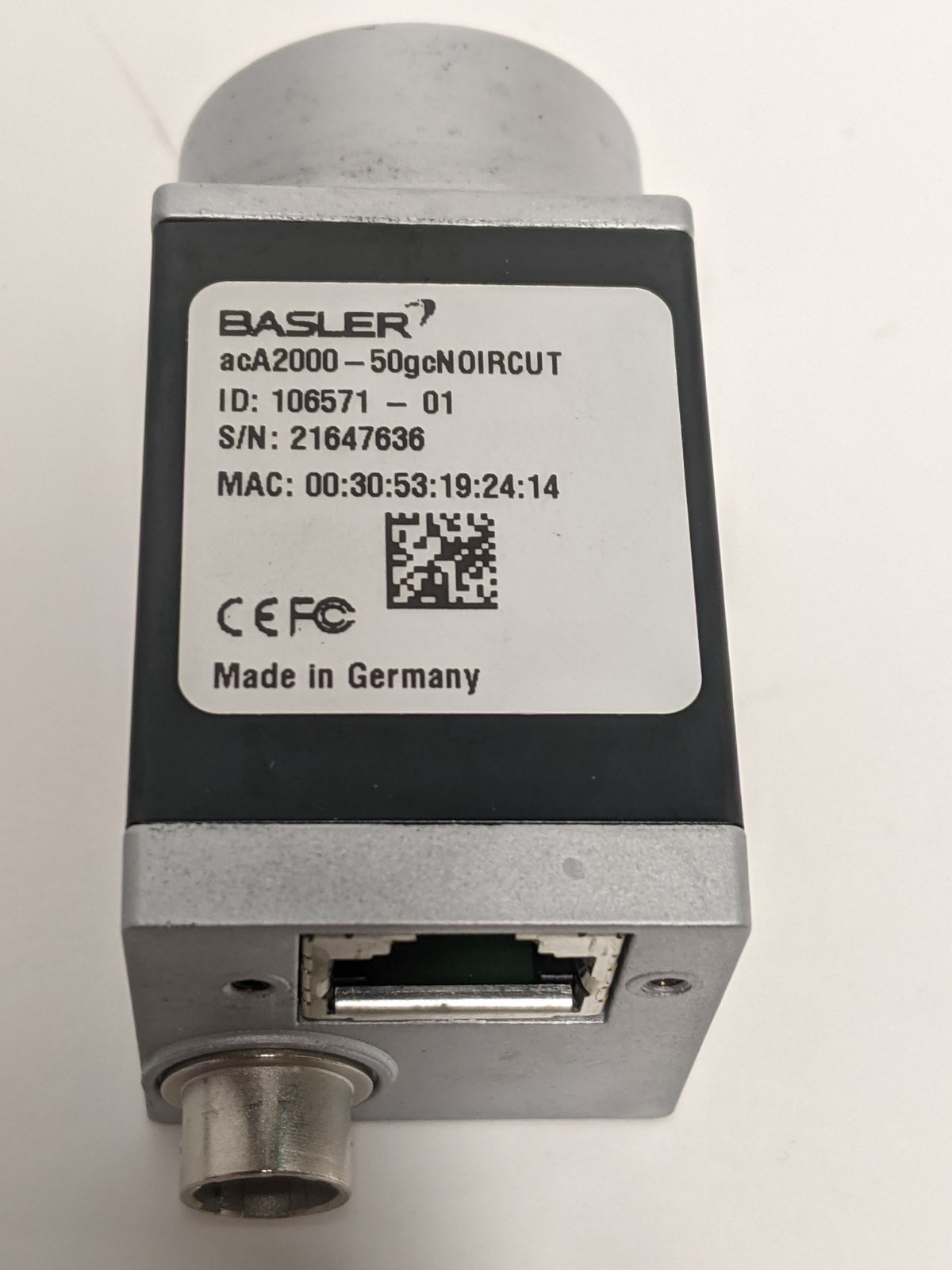
This is the color option in this pairing. Its global-shutter CMOS sensor is specified for 2048 x 1088 resolution and a 50 FPS frame rate, which makes it the better fit for applications where fast motion is part of the identification task. The GigE interface keeps cabling familiar on many existing machine vision setups. It also carries the NOIRCUT designation, which points to a setup without the standard IR-cut filter, so factor that into your lighting plan. On the other hand, this unit is described as For parts or not working, with no power-on or connection testing, plus visible scuffs, scratches, and mounting wear. That limitation makes it the higher-risk pick of the two.
Basler acA5472-17um 20MP USB 3.0 Mono C-Mount Machine Vision Camera
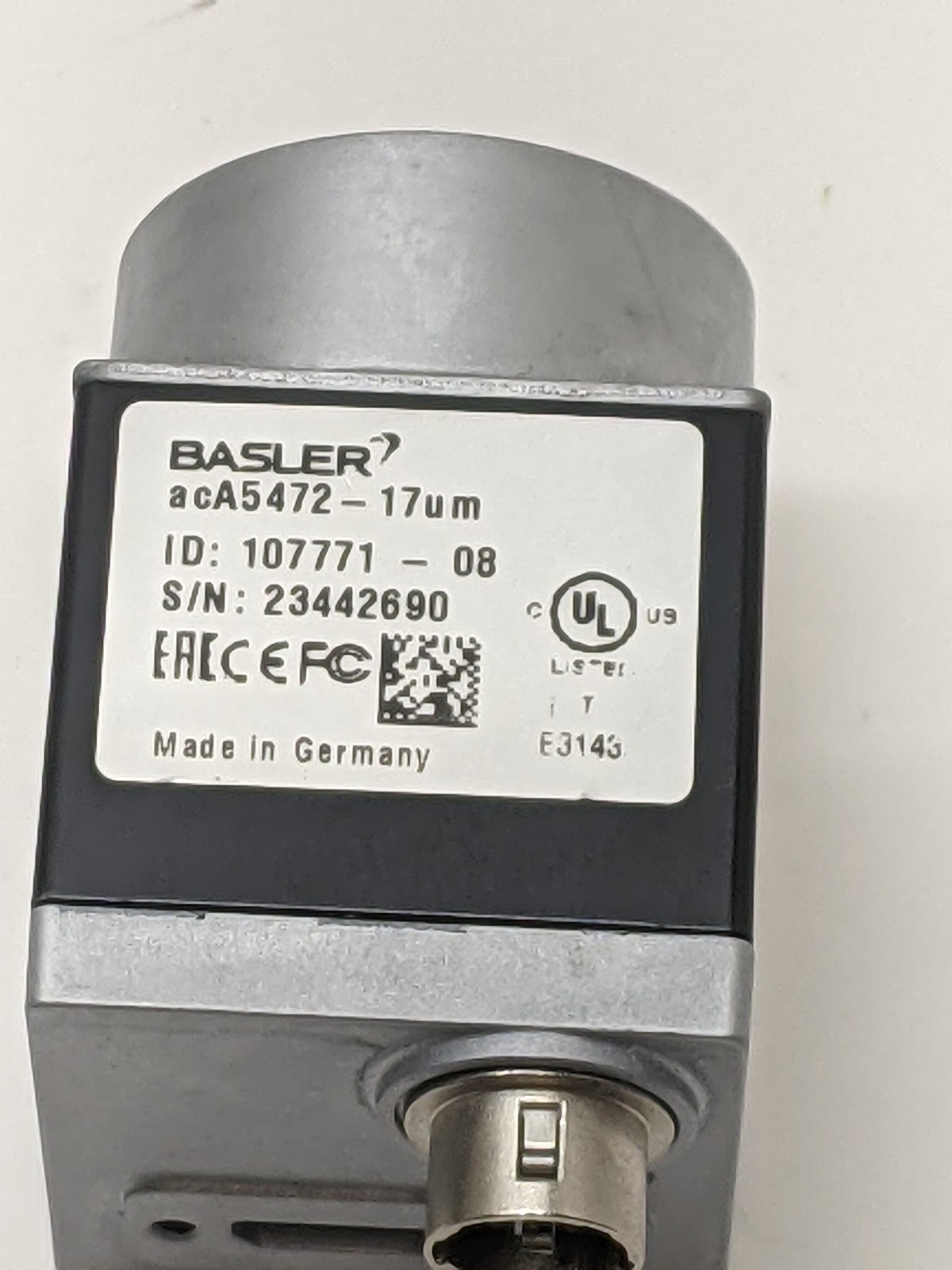
The acA5472-17um is the resolution-focused choice. Its 20 MP Sony IMX183 CMOS sensor is specified for 5472 x 3648 output, and the USB 3.0 SuperSpeed interface delivers data through a USB 3.0 Micro-B connector. The camera is powered over USB and has a rear Hirose 6-pin connector for I/O triggering, which suits machine vision identification systems that already rely on USB 3.0 capture. Its 17 fps frame rate is lower than the acA2000's 50 FPS, and the monochrome sensor means you need external color handling in software. The useful caution: no functional testing was performed, and the housing shows normal wear plus a small dent. If you can accept an untested used unit, the 20 MP resolution is the strongest argument for this camera.
Final choice by use case
- Choose the Basler acA5472-17um if your machine vision identification task centers on high detail on a still or slow-moving subject, you are already on USB 3.0, and you can work with monochrome output.
- Choose the Basler acA2000-50gcNOIRCUT if you need color at up to 50 FPS over GigE, you understand the NOIRCUT caveat, and you are prepared to treat an untested For parts or not working unit as a repair project.