When you're piecing together a machine vision identification station, the camera choice often comes down to one balancing act: how much detail you need per frame versus how many frames per second you can sustain, and whether your computer's interface can keep up. The Basler acA5472-17um enters that conversation with a strong resolution story.
Quick verdict
The Basler acA5472-17um is a 20MP monochrome area-scan camera with a C-mount, USB 3.0 interface, and 17 fps output. If your inspection or identification task rewards high-resolution stills and you already work with C-mount lenses, this camera's specs are easy to get behind. But this particular unit is used, shows a small dent, comes without lens or cables, and its operational status is not confirmed. That shifts the decision: the specs are right, but your trust in the unit's physical condition matters.
Who it suits
The camera is for builders and integrators who need fine detail in a compact form factor. With a 20MP Sony IMX183 sensor at 5472 x 3648, it's well suited for PCB inspection, label inspection, or any machine vision identification application where surface details like barcode micro-print or tiny defect features need to be captured in one shot. The 17 fps frame rate is comfortable for static or slow-moving objects, but not for racing lines moving quickly past the sensor.
What stands out from the listed details
The core specs are what make this camera interesting: 20MP resolution, monochrome output for high contrast and sensitivity, USB 3.0 for straightforward host connection, and a C-mount to attach a wide range of machine vision lenses. The camera is also powered over USB, which simplifies cabling in a tight system. A rear Hirose 6-pin I/O connector adds triggering and system integration options. All that sits in a Germany-built Basler ace U family body.
What's not included is just as important. The unit ships alone: no lens, no USB cable, no I/O cable, no mounting hardware. The housing shows normal use-related wear and a small dent on one side, and the operational status is not confirmed because no functional testing was performed. The price is listed at USD 449.99.
Meaningful trade-offs
The biggest trade-off is the condition. A used industrial camera can be a smart buy if you're comfortable with cosmetic wear and have the ability to do your own integration. But without confirmation of operational status, you are taking on that risk. The dent is small, but it's a physical sign of previous handling. Also, you'll need to budget for accessories: a C-mount lens, USB 3.0 cable, and possibly a power supply or triggering solution if your system doesn't power and trigger via USB alone.
On the performance side, remember that 20MP frames are large. USB 3.0 is fast, but whether you hit a consistent 17 fps depends on your host computer, cable quality, and software stack. That's not a knock on the camera-just a system-level consideration.
Product note
Basler acA5472-17um 20MP USB 3.0 Mono C-Mount Machine Vision Camera
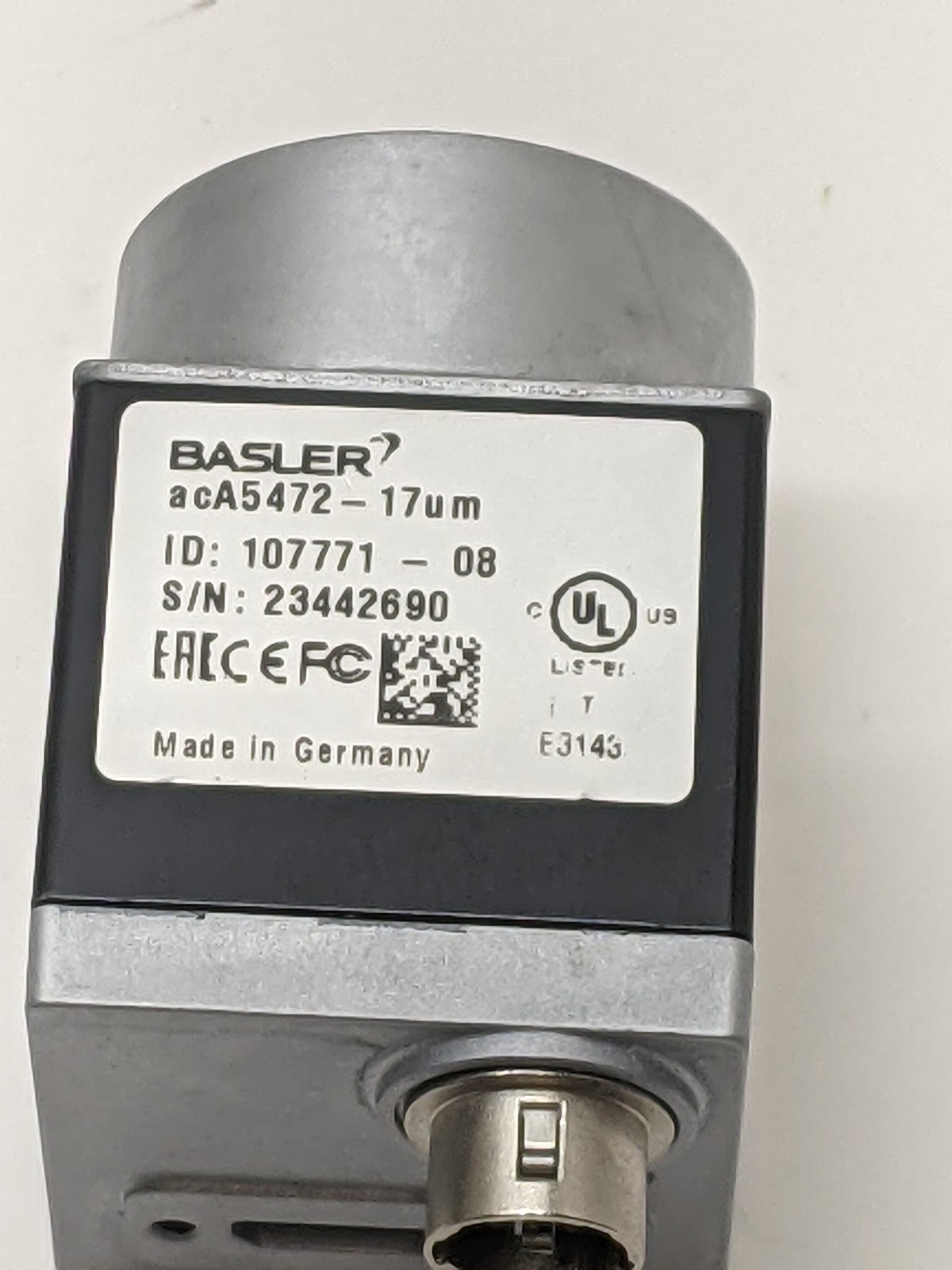
At USD 449.99, this Basler ace U camera gives you a 20MP monochrome sensor (Sony IMX183), 5472 x 3648 resolution, 17 fps, USB 3.0 interface, and C-mount lens connection. The rear Hirose 6-pin I/O connector makes it easier to integrate with other machine vision components. It's powered by USB, so you don't need a separate power brick for the camera itself.
The catch is that the unit comes as-is: no lens or cables, a small dent on the housing, and no functional testing performed. If you're a careful buyer who can inspect and test the camera before putting it into service, this could be a way to get high-resolution machine vision for ID tasks without spending on a new unit. If you need a plug-and-play solution, this is probably not the right fit.
Bottom line
If the Basler acA5472-17um's 20MP monochrome output and USB 3.0 convenience line up with your machine vision identification project, this used unit might be worth the risk-provided you're prepared to handle the lack of accessories and the unconfirmed operational status. It's a high-detail sensor in a familiar form, but your decision should be as much about condition as about specs.