Choosing among microcontrollers & dev boards often comes down to one practical question: do you want a straightforward controller board, or a platform that gives your embedded project more architectural choice? The Raspberry Pi RP2350A USB Development Board focuses on the latter, pairing dual-core ARM and RISC-V processing with USB host/device support. The key decision is whether those features fit your project closely enough to justify a board designed for custom integration.
Quick verdict
At USD 17.78, the Raspberry Pi RP2350A USB Development Board is a focused option for developers interested in the RP2350A's dual-core, dual-architecture setup. Its listed combination of ARM Cortex-M33 and Hazard 3 RISC-V processors, with clock frequency up to 150MHz, gives the board a distinctive technical direction without requiring a general-purpose feature bundle.
It makes the most sense when your project involves embedded firmware development, USB control, or experimentation with the two processor architectures. The physical format matters, though: the stamp-hole design is intended to be welded and integrated into a user-designed baseboard, which can make the workflow less convenient for a quick, standalone setup.
Who it suits
This board suits developers who want to work with USB 1.1 host and device support or use the onboard USB expansion port described as compatible with USB 2.0/1. It is also a reasonable fit for custom electronics projects where integrating a development board into a purpose-built baseboard is already part of the plan.
For a project that simply needs a familiar board for basic coding and bench experimentation, the custom-integration format may be more involved than necessary. That is not a performance judgment; it is a question of how closely the board's physical design matches your build process.
What stands out from the listed details
The core specification is the clearest differentiator. The board combines a dual-core ARM Cortex-M33 processor with a dual-core Hazard 3 RISC-V processor, rather than presenting a single processor family. It also lists 520KB of SRAM and 2MB of on-chip Flash, giving firmware developers specific memory figures to plan around.
USB is another central part of the design. The description identifies host and device support, plus one USB expansion port. That makes USB-oriented embedded work a more directly supported use case than projects that do not need the interface.
Meaningful trade-offs
The same specialized design that makes the board interesting can narrow its appeal. Stamp holes are useful for direct integration into a custom baseboard, but that construction approach adds a hardware-design step before the board becomes part of a finished assembly. Plan around that if your project is not already built for soldered integration.
The dual-architecture arrangement also deserves a clear software plan. Developers should choose the board because they have a reason to work with its ARM and RISC-V configuration, not simply because the processor specifications look distinctive.
Raspberry Pi RP2350A USB Development Board Dual-Core Dual-Architecture Type A US
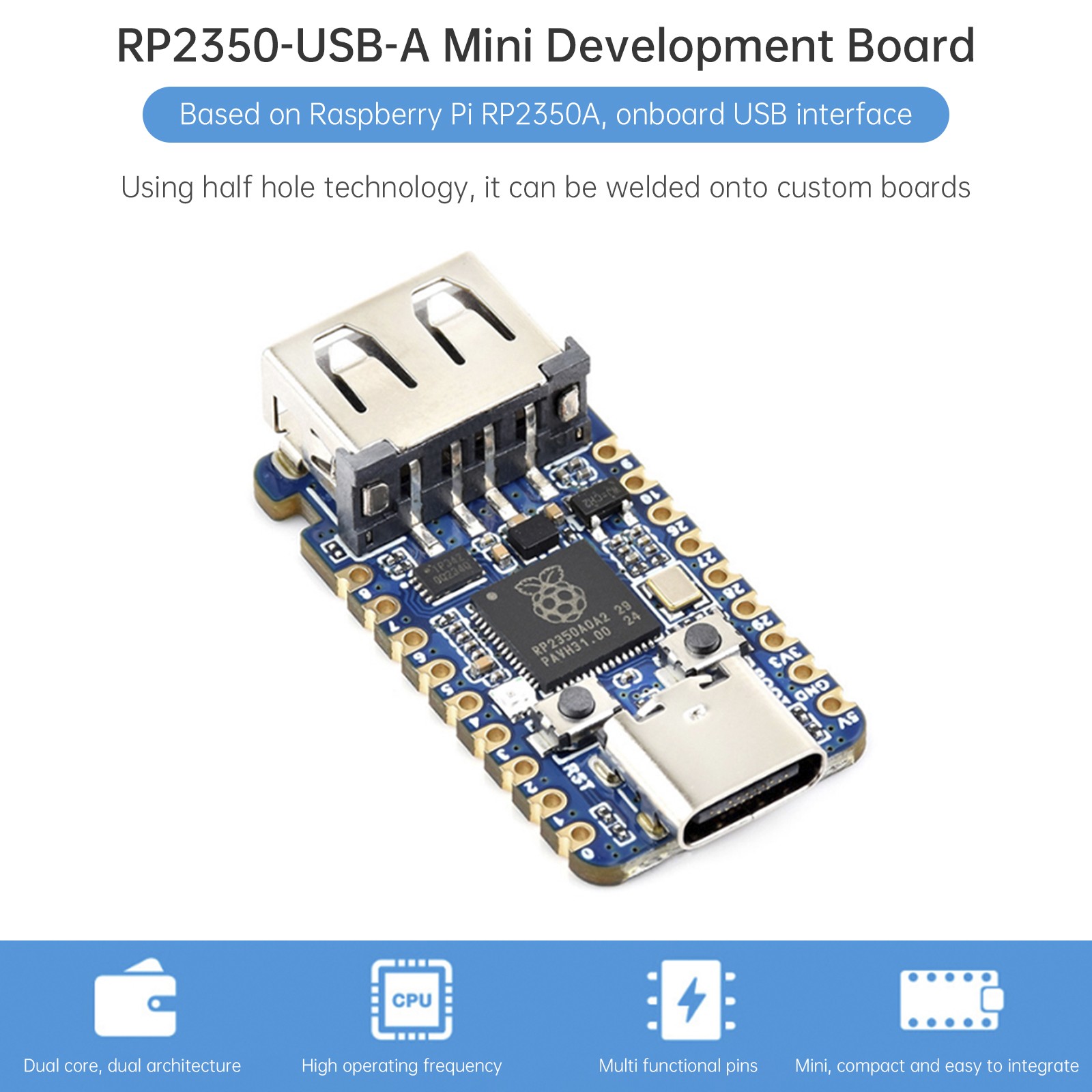
The case for choosing this board is its combination of dual-architecture processing, USB host/device support, and a listed price of USD 17.78. Its main practical limitation is the stamp-hole format, which is oriented toward welding into a user-designed baseboard rather than an entirely hands-off setup.
Bottom line
The Raspberry Pi RP2350A USB Development Board is a sensible match for embedded developers who can use its USB capabilities and want to explore the RP2350A's ARM-and-RISC-V design. Choose it when custom board integration is acceptable; look elsewhere within your project planning when a simpler physical workflow matters more than architectural flexibility.