Choosing the missing piece for your servo stepper motion control setup often comes down to a controller versus a driver. If you're looking to move a stepper motor, you can buy a standalone controller that generates forward/reverse pulses and positioning angles, or you can buy a driver that takes pulse and direction signals and powers the motor coil. Here's a head-to-head look at the SMH 42/57 Stepper Motor Controller and the 3-piece TB6600 Stepper Motor Driver.
Quick verdict
For a self-contained single-axis controller, the SMH is the straightforward pick at $18.79. For a driver bundle with high current and fine microstepping, the TB6600 pack at $23.79 is the one to choose when you need a power stage. The right choice depends entirely on which part of the motion chain you still need: a control brain or a muscle that drives the motor.
Comparison table
| Product | Price | Price indicator | Best for |
|---|---|---|---|
| SMH 42/57 Stepper Motor Controller | $18.79 | Standalone single-axis controls | |
| TB6600 3-Pack Stepper Motor Driver | $23.79 | Multi-axis or high-current needs |
Where each product wins
Choose the SMH 42/57 controller if you want a complete control module with multiple motion presets, power-off memory, and expandable interfaces for a single axis. Its acceleration/deceleration control and DC 6-36V supply range suit basic forward/reverse and positioning-angle jobs.
Choose the TB6600 3-pack if you're assembling a CNC controller or 3D printer driver section. Each driver gives you 0.5-4.0A output, 9-42V input, a 1/2/4/8/16/32 microstep selector, and protection features like overheating, overcurrent, undervoltage, and reverse polarity.
Product notes
SMH 42 57 Stepper Motor Controller Forward/Reverse Pulse Delay Positioning Angle
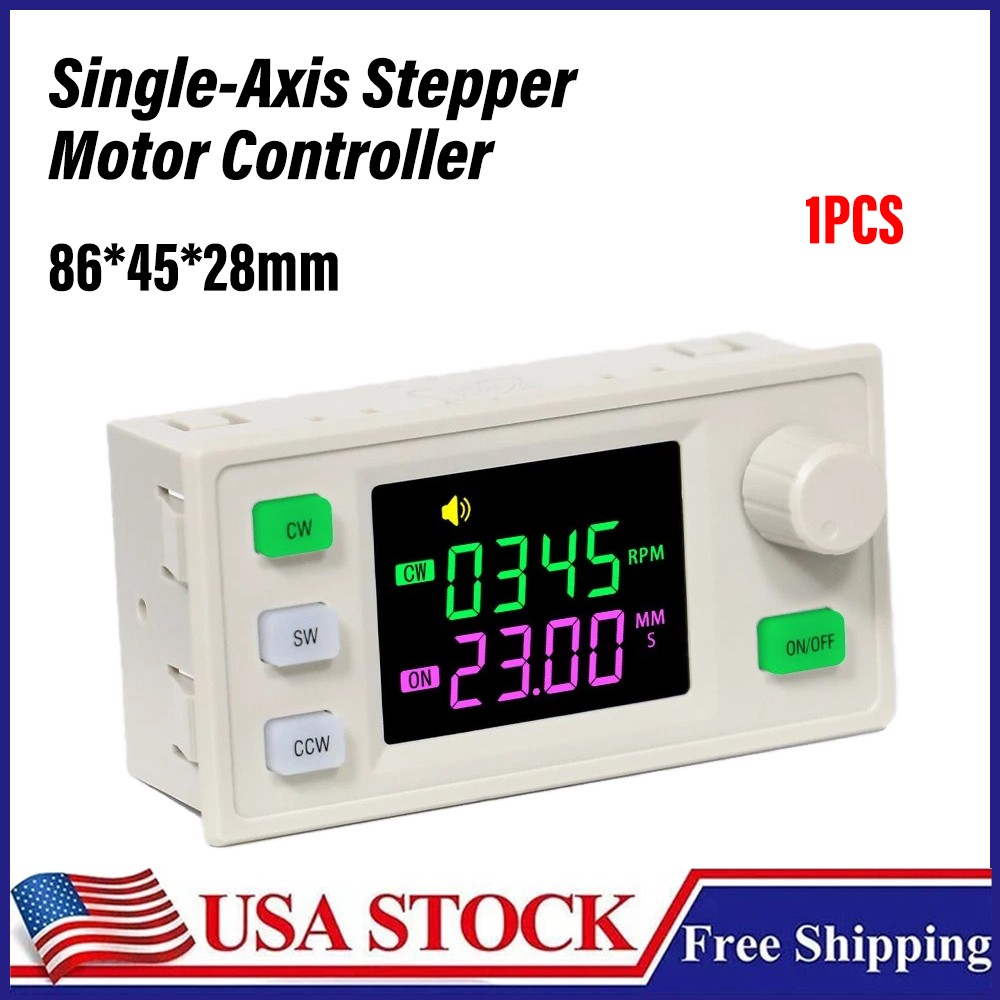
The SMH controller is a single-axis motion control module with built-in operating modes, so you can set up forward/reverse movement and positioning without needing a separate PLC or microcontroller. The power-off memory stores your settings and resumes operation after a restart, which is handy for repeatable tasks. Expandable control interfaces let you connect external sensors or control systems. It also includes acceleration/deceleration control and reverse-polarity protection for the DC 6-36V supply. The trade-off is that it is specifically designed for two-phase four-wire stepper motors and controls just one axis at a time. If your project needs coordinated multi-axis movement or higher-power, higher-voltage drivers, this controller alone won't cover that requirement. It's a good fit for a simple, self-contained positioning task.
3PCS TB6600 Stepper Motor Driver Upgraded 4A 9-42V 32 Microstep CNC Controller
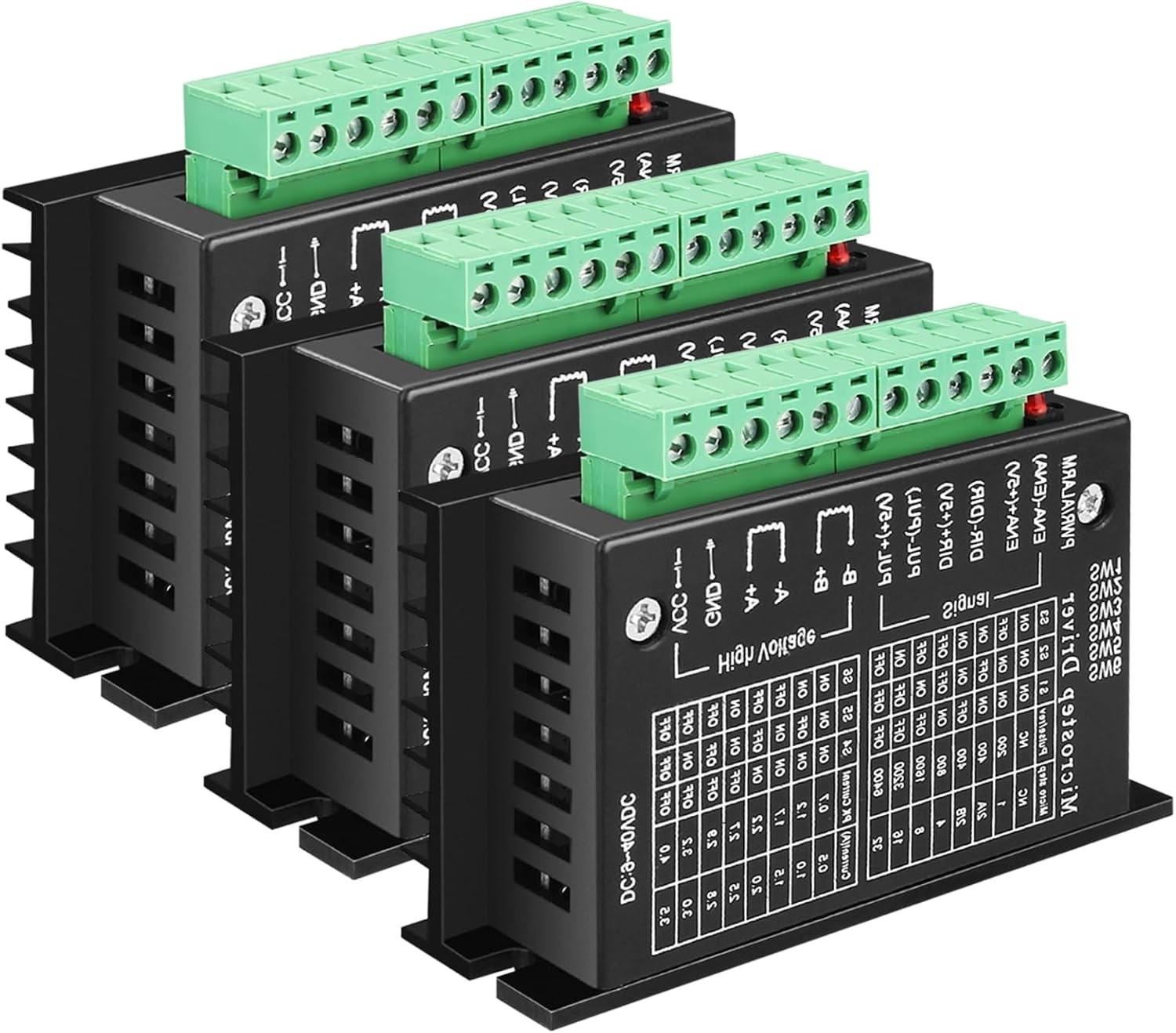
The 3-piece TB6600 pack gives you three identical drivers, which makes it especially practical for multi-axis builds or for keeping a spare on hand. Each unit accepts single-ended pulse/direction signals, supports microstep resolution, and delivers output current from 0.5A to 4.0A using a DC 9-42V supply. The optocoupler-isolated inputs reduce interference, and the built-in protections cover overheating, overcurrent, undervoltage, and input reverse polarity. For NEMA 17 and NEMA 23 motors and similar two-phase or four-phase types, these drivers are designed for that job. The main limitation is that it is not a controller: it needs pulse and direction signals from a CNC board, microcontroller, or other signal source, so it can't operate as a standalone unit.
Final choice by use case
For a single positioning axis with preset modes and memory, the SMH 42/57 controller is the logical pick. For a multi-axis CNC conversion or a driver bank that can feed up to 4A per channel, the TB6600 3-pack takes the slot. If you already own a control board that outputs step and direction, the driver bundle is almost certainly what you need; if you have a motor but no way to generate movement commands, the standalone controller is the missing link.