Choosing between microcontrollers & dev boards often comes down to a simple tension: do you want a straightforward board for learning circuits, or a fuller kit that opens more project directions? The UNO R3 and ELEGOO ESP-32 take noticeably different approaches. One keeps the purchase centered on a development board, while the other combines a board with a guided starter-kit format and a wider connectivity list.
Quick verdict
The UNO R3 is the clearer match for a focused first project built around a development board and Arduino IDE work. ELEGOO is the clearer match when a broader kit format and connected project path matter. The listed-price gap is $42.79: $6.95 for UNO R3 versus $49.74 for ELEGOO. That spread makes the central question simple: do you need a board-centered start, or are the kit's added scope and interfaces part of the plan?
At a glance
| Product | Listed price | Key details | Best fit |
|---|---|---|---|
| UNO R3 Board | $6.95 | ATmega328P, USB, 5V and 3.3V DC output | Focused board projects |
| ELEGOO ESP-32 Super Starter Kit | $49.74 | Tutorial, 35-count unit total, Bluetooth, Wi-Fi, GPIO, I2C, USB | Bundled connected projects |
Where each product wins
- UNO R3: It wins for the beginner-oriented component projects named in its description, including LEDs, buzzers, buttons, and photoresistors. That makes its board-centered format easy to match to basic input and output experiments.
The seller page may include additional marketing claims. Treat this page as a shopping reference, then confirm fit, price, delivery, and returns on the seller page.
Product notes
UNO R3 Board
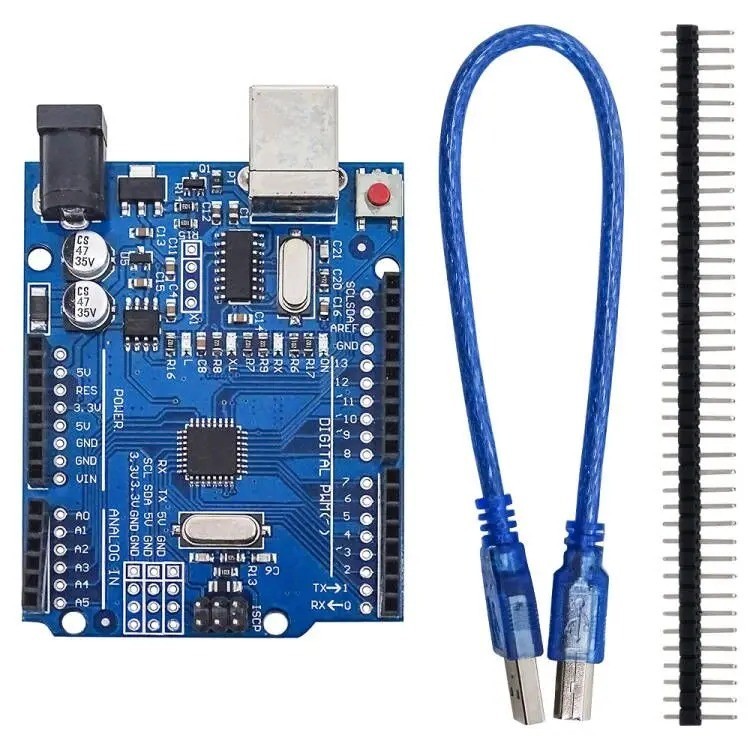
UNO R3 suits a first hands-on build when the goal is to work through LEDs, buzzers, buttons, or photoresistors without choosing a larger kit format. Its description also calls out a pin header and cable, plus a straightforward way to connect components with DuPont lines. That gives it a clear role as a focused board for learning basic input and output projects. The limitation is scope: the title identifies a development board with a USB cable, so it is not framed as the tutorial-led, multi-component package represented by the ELEGOO ESP-32 Super Starter Kit. Choose UNO R3 when a focused Arduino-style project brief is enough; choose ELEGOO when a kit-centered start or listed wireless connectivity is central.
ELEGOO ESP-32 Super Starter Kit
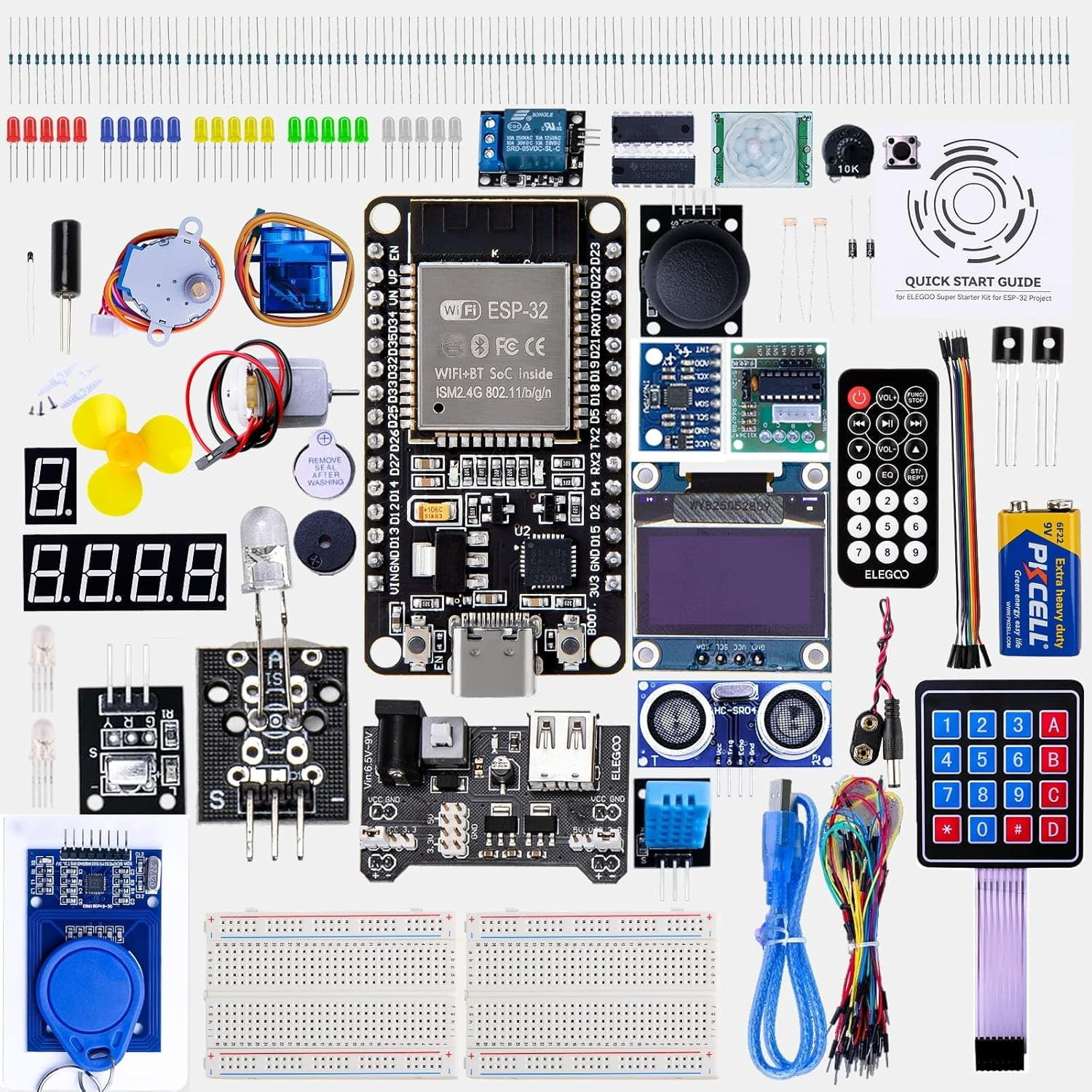
ELEGOO is aimed at the shopper who wants a project package rather than a board-only purchase. The title pairs the ESP-32 development board with a tutorial, while its listed connectivity spans Bluetooth, Wi-Fi, GPIO, I2C, and USB. That combination gives it a concrete role for experiments that may move between wireless and wired control, or for a learner who wants guidance alongside the board. The trade-off is the kit format itself: if your brief is limited to a basic Arduino project, the package covers a wider scope than you may need. Pick ELEGOO when the tutorial, bundled setup, or connectivity list directly matches the builds you have in mind.
Final choice by use case
- For a board-centered purchase and the listed 5V and 3.3V DC outputs: choose UNO R3 Board.
- For a kit-centered build involving wireless or bus interfaces: choose ELEGOO ESP-32 Super Starter Kit.
- For beginner component experiments: UNO R3's description names a direct path through LEDs, buzzers, buttons, and photoresistors.
- For guided, connected projects: ELEGOO's tutorial-led starter-kit format is the more closely matched choice.
In short, UNO R3 keeps the decision focused on a development board, while ELEGOO makes sense when the starter-kit format and broader interface list are part of the plan.