Choosing among sensors, modules & components comes down to what your next build actually needs: a collection of project-facing modules to experiment with, or a deeper assortment of discrete parts for assembling circuits. These kits point in opposite directions, so the lower listed price is not the whole decision. Match the kit to the workbench task first, then use the price difference as a tie-breaker.
Quick verdict
Pick the 38 in 1 Sensor Module kit for Arduino/Rapsberry Pi Project for Arduino-centered sensor and interface experiments. Its title identifies a 38-in-1 format, while the attributes specify an Arduino core and a sensor-kit name.
Choose the Electronic Components Kit 1390PCS LED Diodes Resistors Electrolytic Capacitors g when the project calls for discrete LEDs, resistors, and capacitors in multiple listed values. Its emphasis is component quantity and assortment rather than sensor modules.
Side-by-side comparison
| Comparison | 38 in 1 Sensor Module Kit | 1390PCS Electronic Components Kit |
|---|---|---|
| Listed price | USD 12.00 | USD 18.05 |
| Stated orientation | Arduino; 38in1 Sensor Kit | LED diodes, resistors, electrolytic capacitors, ceramic capacitors |
| Distinctive listed contents | Reed, temperature, IR, buzzer, button, RGB LED, and OLED modules | Five LED colors, resistor values from 10Ω through 1M, and multiple capacitor values |
Where each kit wins
- Sensor-focused prototyping: The 38 in 1 kit is the more relevant choice when the project brief names an OLED module, IR receiver, photoresistor, rotary encoder, or another sensor/interface part.
- Discrete circuit assembly: The 1390PCS kit fits better when the parts list calls for selecting among LED colors, resistor values, and capacitor values.
- Different kinds of variety: The sensor kit varies by module function; the components kit varies by part type, value, and quantity. That distinction matters more than the headline number in either title.
Product notes
38 in 1 Sensor Module kit for Arduino/Rapsberry Pi Project
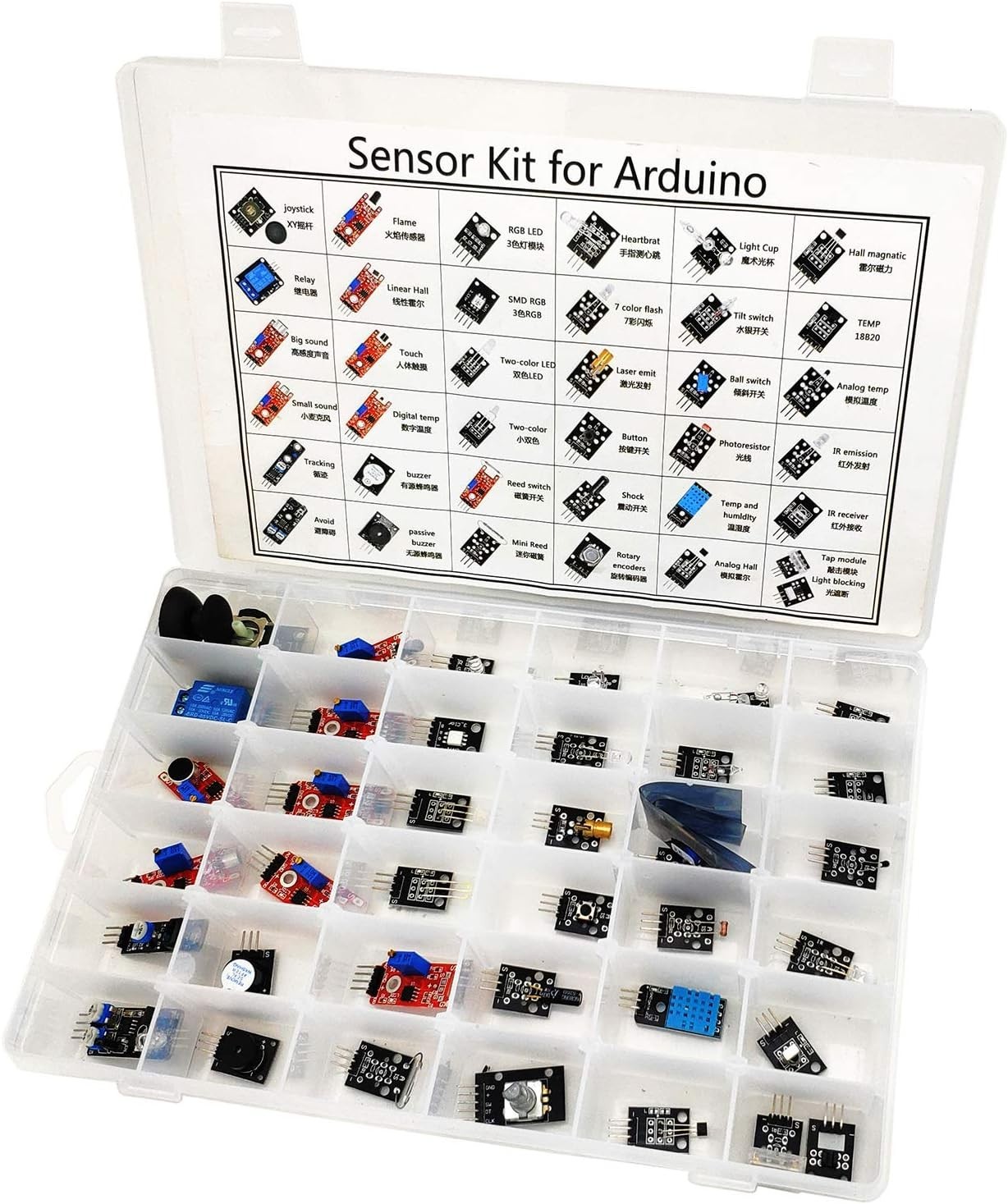
The 38 in 1 Sensor Module kit makes sense when a project needs several kinds of inputs, indicators, and small interface pieces in one Arduino-oriented package. Its description names reed, tilt, shock, and tap modules, along with active and passive buzzers, a temperature module, RGB LED modules, and a 0.96-inch OLED module. That mix gives it a concrete reason to choose: it covers many experiment directions without centering the purchase on individual resistor or capacitor values. The limitation is its stated focus. The listed contents are sensor and interface modules, so it is not the direct match for the large discrete-component assortment described for the competing kit.
Electronic Components Kit 1390PCS LED Diodes Resistors Electrolytic Capacitors
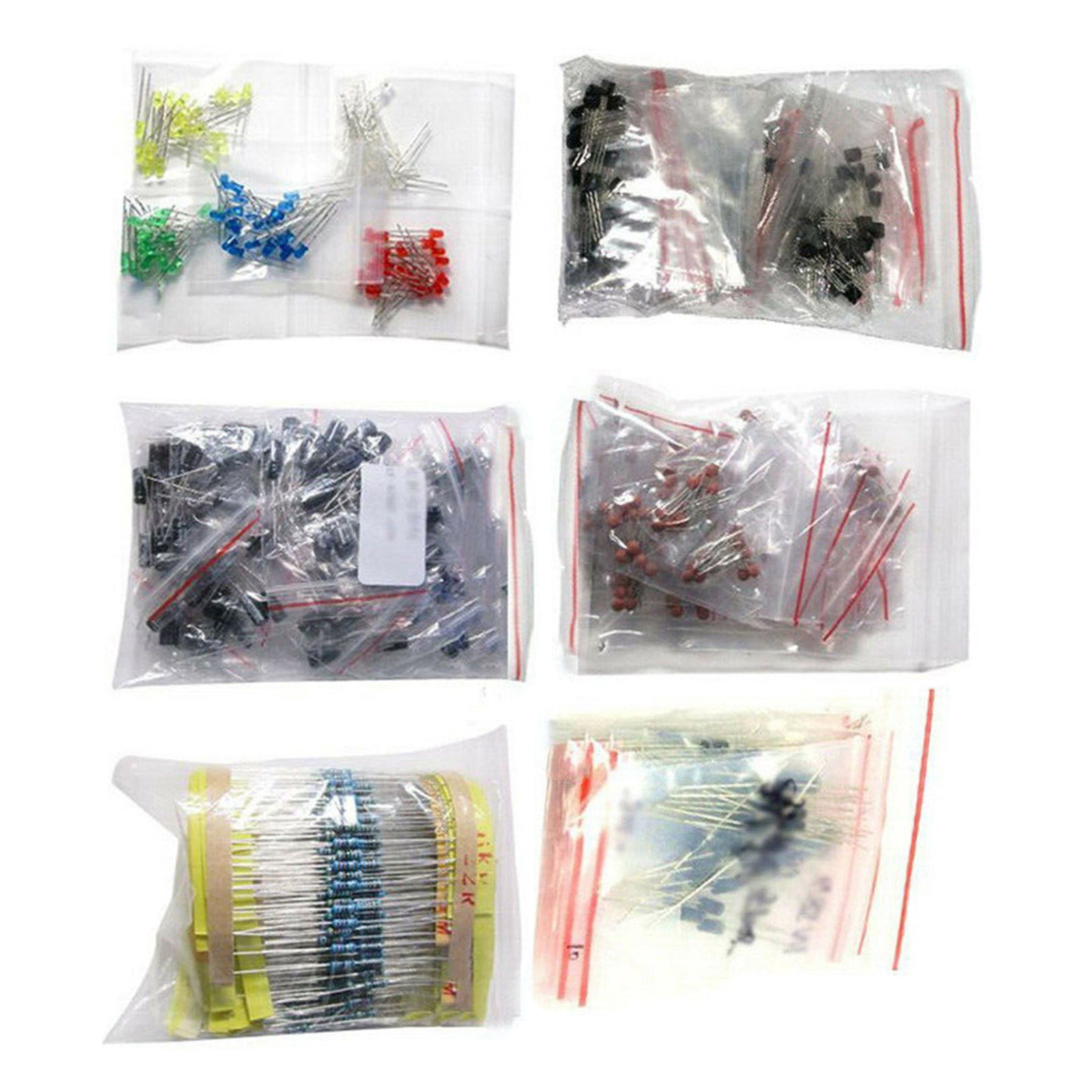
The Electronic Components Kit 1390PCS LED Diodes Resistors Electrolytic Capacitors g is aimed at circuit work built around discrete parts. The description specifies 100 LED diodes in five colors, 600 1/4W resistors across 30 values, 120 electrolytic capacitors across 12 values, and 30 kinds of ceramic capacitors. Those concrete quantities and categories make it the stronger fit for projects that repeatedly call for component values rather than individual sensing functions. Its limitation is the reverse of the sensor kit's: the stated assortment centers on LEDs, resistors, and capacitors, not the buzzer, switch, temperature, IR, or display modules named for the other kit. Choose it when component variety is the primary task.
Final choice by use case
- Arduino sensor and interface projects: Choose the 38 in 1 Sensor Module kit for Arduino/Rapsberry Pi Project, especially when the named mix of sensing, switching, sound, light, and display modules matches the build.
- Discrete electronics assembly: Choose the Electronic Components Kit 1390PCS LED Diodes Resistors Electrolytic Capacitors g for its listed LED, resistor, and capacitor assortment.
- Price-led decision: The sensor kit is listed at $12.00, a $6.05 spread below the components kit's $18.05 price. That makes it the lower-cost route, but only when a sensor-module mix-not a discrete parts assortment-is what the project requires.