Choosing between two sensors, modules & components kits is a trade-off between open-ended variety and a more directed Arduino learning path. The 38 in 1 Sensor Module kit for Arduino/Rapsberry Pi Project and the Upgraded 37 in 1 Sensor Modules Kit with Tutorial Compatible with R3 MEGA 2560 N are separated by $54.90. The lower-priced kit emphasizes a wide mix of individual modules, while the pricier one names board compatibility and tutorial support. The fastest useful decision is to match the kit's emphasis to your next build-not to choose by the number in the name alone.
Quick verdict
Choose the 38 in 1 Sensor Module kit if you want a broad assortment for open-ended experiments across Arduino and Raspberry Pi projects. Choose the Upgraded 37 in 1 Sensor Modules Kit if you want a more defined Arduino learning path with explicit board-family compatibility and tutorial material. The first is about exploring many module types; the second is about a more structured project direction.
Listed-price comparison
| Kit | Listed price | Decision cue |
|---|---|---|
| 38 in 1 Sensor Module kit for Arduino/Rapsberry Pi Project | USD 12.00 | Broad sensor-kit assortment |
| Upgraded 37 in 1 Sensor Modules Kit with Tutorial Compatible with R3 MEGA 2560 N | USD 66.90 | Board-family-focused package |
Where each kit wins
38 in 1 Sensor Module Kit
This kit wins for open-ended project exploration. Its title explicitly frames it for Arduino and Raspberry Pi projects, while the description reaches from reed, temperature, IR, photoresistor, hall, tilt, and shock modules to buzzers, buttons, RGB LEDs, and an OLED. If your next build is not yet defined, that range is a concrete advantage. Its USD 12.00 price also makes it the straightforward choice for shoppers who want the lower-cost route into a varied electronics assortment.
Upgraded 37 in 1 Sensor Modules Kit
This kit wins for a defined Arduino learning route. It names compatibility with Arduino UNO R3, Arduino MEGA R3, and Arduino NANO, and highlights the GY-521 accelerometer, LCD1602 screen, DS1307 real-time clock, and an upgraded tutorial. Choose it when those parts and board families map directly to your project plan. The USD 66.90 price is easier to justify when the guided package matters; it is a less direct fit for someone who only wants a broad assortment of individual modules.
Product notes
38 in 1 Sensor Module kit for Arduino/Rapsberry Pi Project
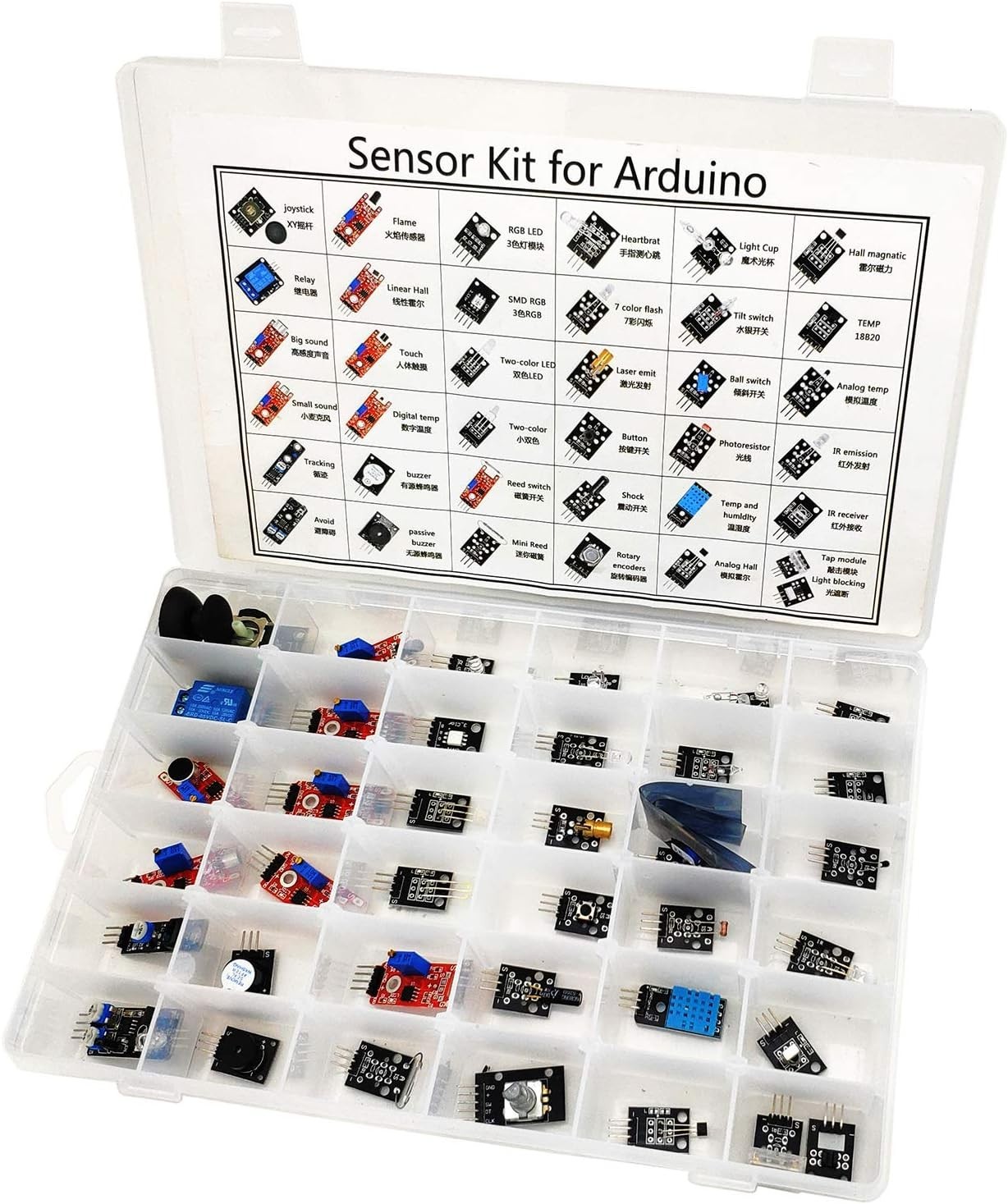
The 38 in 1 kit is aimed at exploration across many small project functions. Its description names active and passive buzzers, a button module, ball and tilt switches, a rotary encoder, heartbeat detection, laser emission, tap detection, RGB LED modules, and a 0.96-inch OLED module. That mix is the concrete reason to choose it: you can move between input, sound, light, and display experiments without narrowing the kit to one project type. The limitation is direction rather than variety; compared with the other kit, its title gives broad Arduino/Rapsberry Pi project framing instead of a named board-family learning route. It suits curious builders who want to explore modules first.
Upgraded 37 in 1 Sensor Modules Kit with Tutorial Compatible with R3 MEGA 2560 N
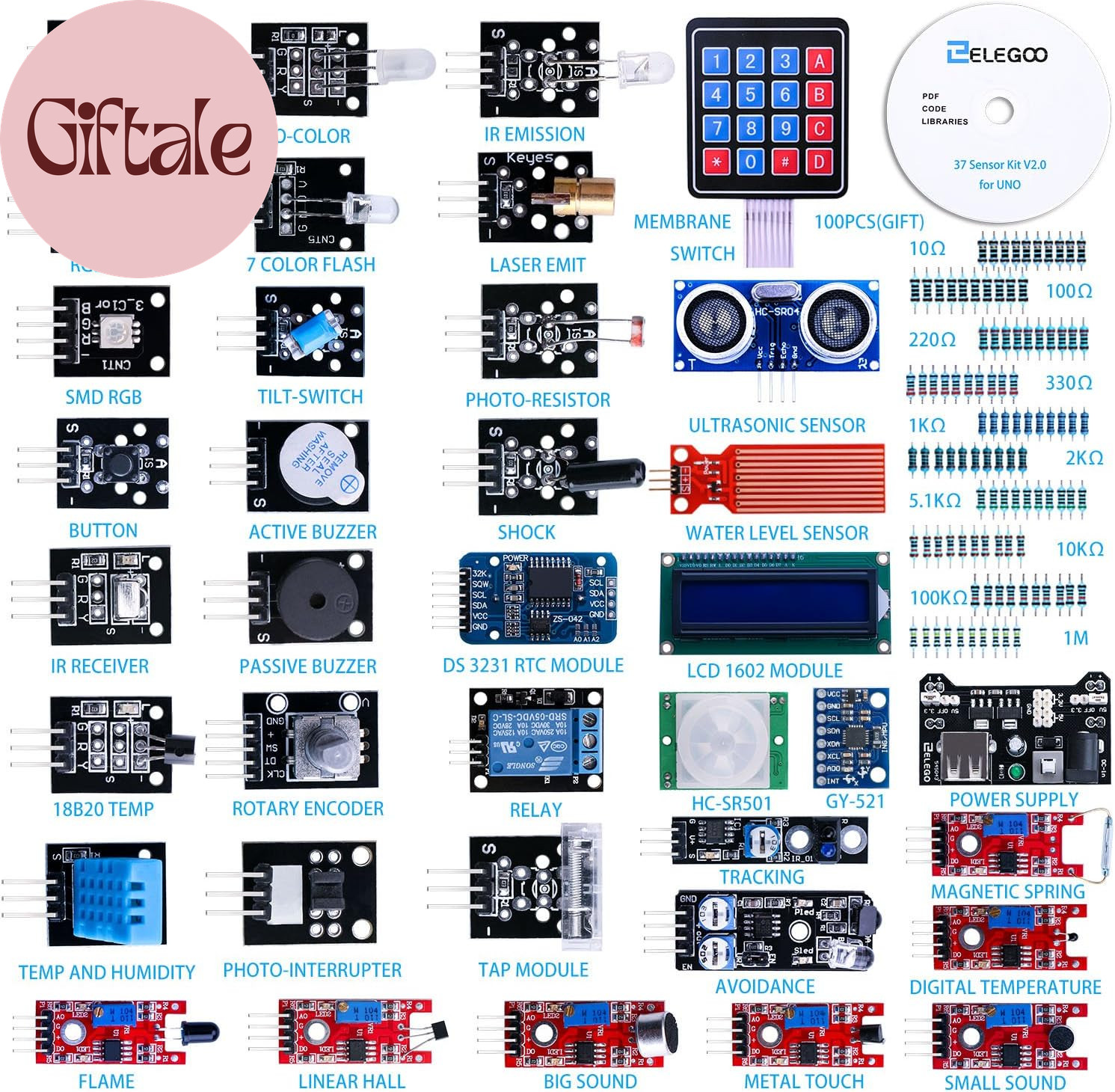
One reason to choose this kit is its more defined package format. Alongside the module assortment, the description includes a CD and listing paper, giving the tutorial-led setup a concrete starting point for projects built around compatible Arduino boards. Its strongest limitation is explicit: boards are not included, so the kit does not itself provide the UNO, MEGA, or NANO hardware named in its compatibility scope. That matters if you are assembling a complete setup rather than adding modules to boards you already have. The package fits shoppers who prefer a guided route with a clear Arduino focus, while the broader kit is better suited to less predetermined experimentation.
Final choice by use case
- For open-ended sensor experiments: Choose the 38 in 1 Sensor Module kit. Its Arduino/Rapsberry Pi project framing and varied mix of sensors, switches, sound, light, and display modules suit flexible builds.
- For guided Arduino work: Choose the Upgraded 37 in 1 Sensor Modules Kit. Its named UNO R3, MEGA R3, and NANO compatibility, tutorial, GY-521, LCD1602, and DS1307 make the project path more specific.
- If price is decisive: The $54.90 difference points clearly to the 38 in 1 kit; select the Upgraded 37 in 1 kit when its board-focused tutorial package matches your intended projects.